
|
True corporate fashion does not come from a catalogue. It is developed, designed, sampled and produced from the identity of a company. That is exactly why it takes time.
|
When corporate fashion is supposed to be finished within a few days, it is usually not true corporate fashion.
In most cases, we are talking about ready-made catalogue products that are selected, branded with a logo and delivered. That can make sense for quick promotions, events or short-term campaigns. But it is not the same as clothing that has been developed from the actual identity of a company.
True corporate fashion takes time because it does not begin with the product. It begins with the company itself.
That is the difference between quick staff clothing and true corporate fashion.
Many companies first think of a garment when they hear corporate fashion. A polo shirt. A shirt. A jacket. A hoodie. Maybe with a logo, in matching colours and in the right quantity.
That is understandable. But it is too limited.
True corporate fashion is not a finished product taken from a shelf. It is a developed visual appearance. Clothing is not simply selected. It is deliberately designed. It has to fit the brand, the company culture, the industry, the target group, the working environment and the people who wear it.
A company built around technical precision needs a different textile language than a creative service provider. A premium business has a different presence than a young start-up. A craft business has different requirements than a hotel, a clinic, a car dealership or an industrial company.
That is why true corporate fashion cannot be created in just a few days. The foundation has to be understood first.
Before a design is created, it has to be clear what it should stand for.
What does the company radiate? What should it communicate? Which values should become visible? How do employees appear? What role does clothing play in customer contact? Should the effect be premium, approachable, technical, modern, classic, sporty or reduced?
These questions are not theoretical luxury. They determine whether corporate fashion later just looks nice or truly fits the brand.
That is why every project starts with idea development and company analysis. Only when the desired effect is clear does it make sense to talk about lines, cuts, colours, materials and details.
Anyone who skips this step does not really save time. They only risk ending up with clothing that has been produced but has no real connection to the company.
After the analysis, the design phase begins.
This is not about simply drawing something beautiful. Design has to work. It has to fit the brand, be wearable, remain feasible in production and function for different employees.
Good corporate fashion design connects several levels:
As a rule, a design is not perfect in the first draft. That is normal. It usually takes two rounds of adjustments until lines, proportions, details and the overall impression really feel right.
This is where quality is created.
Not by chance. Through development, correction and fine work.
Once the design is defined, one of the key decisions follows: the material.
Material determines how clothing drapes, how it feels, how it is cared for, how long it lasts and how premium it appears. A cut can be excellent. If the material is wrong, the result will not work.
In many projects, existing materials can be used. That is often sensible and efficient. Around 70 percent of requirements can often be solved well with existing fabrics, qualities or material blends.
But not always.
In roughly 30 percent of projects, individual solutions are needed. Then the work is about specific colours, special structures, particular functions, custom weaves, adapted material weights or precisely defined properties.
In that case, the material is not simply ordered. It is developed, woven, dyed or produced according to concrete specifications.
That takes time. But it also makes the difference.
Because a material that fits the brand, the use case and the design lifts corporate fashion to a completely different level.
A lot can look good on paper. What matters is the first real sample garment.
Only with the sample can you see whether design, material, cut, proportion and impact work together.
Does the fabric fall correctly? Does the cut fit as intended? Does the colour in the real material look the way it was planned? Do details, seams, finishing and brand placement work together? Does the garment feel like something employees will actually enjoy wearing?
This step is important because corporate fashion is not only designed. It is worn.
A sample is therefore not an unnecessary intermediate step. It is the first real quality check. This is where it becomes visible whether the textile idea also works in reality.
And just like in every good craft, changes are still possible at this stage. Small corrections to cut, length, material, workmanship or details can make a major difference in the end.
By this point alone, several weeks may already have passed.
And that is not a sign of slowness. It is a sign of clean work.
Before serial production can begin, analysis, design, material selection, pattern development, sampling and approval all have to be completed. Only when the sample garment truly convinces does the actual production start.
In serial production, the focus is then on every detail:
These steps also take time. Especially when clothing is not supposed to be produced somehow, but cleanly, durably and in line with the brand.
In the end, the result is not just a garment. It is a visible part of the company’s identity.
Important: catalogue clothing is not automatically bad.
For a trade fair, a short-term activation, an event or a quick campaign, ready-made clothing with a logo can make perfect sense. If something is needed next week, there are clear limits. Then a pragmatic decision has to be made.
But companies should not believe that these solutions replace true corporate fashion.
Catalogue products can pick up colours. They can carry a logo. They can create a quick sense of uniformity.
But they rarely capture the depth of a company. They are not developed from brand identity. They only consider company culture to a limited extent. And they always remain within the possibilities offered by the catalogue.
True corporate fashion begins where standard products end.
Many companies are concerned that individual corporate fashion will become extremely time-consuming for them.
In practice, that is usually not the case.
Of course the process takes time. But most of the work happens in the background. Analysis, design development, material research, production coordination, sampling, technical execution and quality control are professionally managed and prepared.
The company does not have to solve every single production step itself. It is guided through the process and receives the relevant decisions in a clear, structured way.
What the company has to invest above all is one thing: a clean decision at the beginning.
What should the clothing achieve? What effect should it create? How important is a professional, long-term appearance to the company?
When these questions are taken seriously, corporate fashion becomes more than staff clothing.
It becomes a visible part of the brand.
Corporate fashion is worn every day. It is visible in customer contact. It works inside the team. It shapes photos, videos, trade fair appearances, retail spaces, reception areas, external appointments and the first impression of a company.
That is why it is risky to treat it too quickly and too superficially.
Good corporate fashion strengthens:
The greater effort at the beginning pays off because the result works for longer. A good garment does not disappear after an advertisement, after a social media post or after a campaign. It remains visible in everyday life.
That is exactly why corporate fashion is not just an expense. It is an investment in impact, identity and trust.
True corporate fashion takes time because it is more than a logo on ready-made clothing.
It is created through analysis, design, material, cut, sampling, production and quality control. Each of these steps has a purpose. And each of these steps determines whether clothing is merely worn or truly makes an impact.
Companies that take corporate fashion seriously should not treat it like a quick purchase. It is too visible for that. Too close to the brand. Too important for the first impression.
Fast clothing can help in the short term. True corporate fashion builds identity in the long term.
And that is exactly why the time is worth it.
Corporate fashion does not begin with a product. It begins with a clear decision.
If clothing is supposed to visibly represent your company, standard products are rarely enough. It needs a concept that brings together brand, employees, material, cut and impact.
At René Aurel Corporate Fashion, we do not develop staff clothing from a catalogue. We develop it from the identity of a company.
Read more
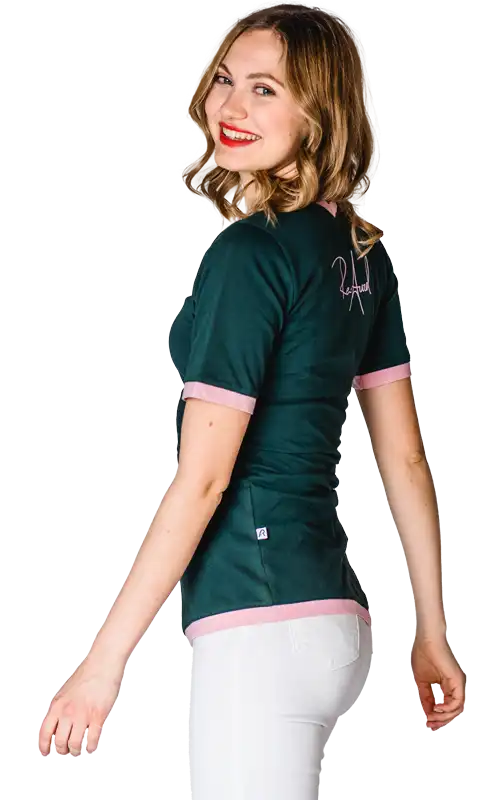
If your clothing feels interchangeable, the problem is usually not the textile alone. What is missing is a clear system of brand, cut, material, function and impact.
For companies that do not see clothing
as standard goods, but as part of their identity.