
|
Corporate fashion only works when people actually enjoy wearing it. And that starts with one thing: fit.
|
Clothing that fits well is worn with confidence.
Clothing that fits badly is avoided.
In private life, this is completely normal. Nobody willingly buys a shirt, jacket or polo that feels uncomfortable. People pay attention to cut, length, fabric, freedom of movement and how they look in it.
With employee clothing, this point is often ignored.
A standard product is ordered from a catalogue, a logo is added, and then companies expect the team to wear it with pride. That is naive. Corporate fashion is not successful just because it exists. It is successful when people wear it, feel good in it and show that through their appearance.
Many companies think of colour, logo, price and delivery time first when it comes to corporate fashion. That is understandable, but it is not enough.
The most important question is not:
“How quickly can we get clothing with our logo?”
The real question is:
“Will our team actually enjoy wearing this clothing?”
This is where fit becomes decisive.
But if the cut does not fit, all of that loses its value.
Too tight, too wide, too short, too long, unflattering or uncomfortable when moving: poor fit is felt every single day. That is exactly why this kind of clothing often disappears into lockers, cars, storage rooms or is only worn when absolutely necessary.
That is not corporate fashion.
That is mandatory clothing without impact.
Catalogue clothing is made for mass use. It has to serve as many companies, industries, body types and budgets as possible at the same time. That is why it is often a compromise.
This does not mean that every catalogue product is bad. But it does mean one thing:
A standard cut can work. But it does not have to.
Especially in corporate fashion, “good enough” is not good enough. Employees often wear this clothing for many hours. In sales, at reception, at trade fairs, in client meetings, in service, in workshops or in the field.
This clothing becomes part of everyday work.
If it restricts, pinches, pulls or simply looks wrong, it does not support the company. It works against it.
Clothing influences how people move, present themselves and are perceived.
When someone feels comfortable in their clothing, you can see it. Their posture changes. Their appearance becomes more confident. Conversations with clients feel more professional. They are not hiding inside their clothing — they stand in it.
That sounds simple, but it matters.
An employee who feels comfortable in their second skin appears different. More present. More confident. More polished. More motivated.
And yes, this also affects consultation, sales and customer contact.
Not because a better-fitting polo suddenly turns everyone into a top salesperson. But because clothing influences first impressions, body awareness and inner attitude.
People who feel well dressed present themselves differently.
Employees notice very quickly whether clothing was simply bought in a hurry or whether the company actually thought about them.
When a company says:
“Wear this. The main thing is that our logo is visible,” that sends a message.
But when a company says:
“We are developing clothing that fits you, your work and our brand,” that also sends a message.
And the second message is much stronger.
Good corporate fashion shows appreciation. It tells the team: You are visible. You are part of the brand. You should feel comfortable. You should not have to wear some cheap standard piece just because it was available quickly.
That is not luxury thinking.
That is company culture you can wear.
One of the biggest problems with standard clothing is the idea that one cut should work for everyone.
In practice, that rarely works.
People have different body shapes, proportions, sizes, preferences and movement patterns. Some need more length. Others need more width. Some feel comfortable in more tailored cuts, others do not. Some need robust freedom of movement, others need a clean, calm silhouette.
Good corporate fashion takes this into account.
It is not about developing a completely individual garment for every single person. But it is about planning cuts, sizes, fabrics and variations in a way that real people can actually enjoy wearing them.
Fit does not mean “somehow wearable.”
Fit means the clothing works with the body, not against it.
Fit is not created by the cut alone. The material also plays a decisive role.
A fabric can be stiff or soft. It can move well or feel rigid. It can be stretchy, shape-retaining, breathable, heavy, light, smooth or textured.
A good cut only works properly when the material supports it.
A polo shirt for an active team needs different qualities than a shirt for consulting or reception. A jacket for field service and trade fairs has different requirements than a hoodie for internal teamwear. Corporate fashion must therefore always be considered holistically.
Design, cut, material, function and brand impact must work together.
This is exactly where real corporate fashion separates itself from simple clothing with a logo.
Many companies save money in the wrong place when it comes to employee clothing.
They quickly order something from a catalogue because it looks cheaper. Then the problems begin:
The sizes do not fit properly.
Part of the team does not like wearing the clothing.
Some items remain unused.
Orders have to be changed, exchanged, compared and replaced.
The next time, the whole search starts again.
That costs time, energy and ultimately money.
Good corporate fashion needs more attention at the beginning. But the result is a clothing line that works. Once properly developed, it can be used long term, reproduced and continued.
That is the decisive difference:
Catalogue clothing often solves a short-term procurement problem.
Corporate fashion solves a long-term brand and team issue.
Clients notice more than companies often think.
Corporate fashion is a visible part of the brand. It stands directly in front of the client. Not as an advert, not as a banner, not as a theoretical branding concept — but as a person.
That is exactly why it has to fit.
When clothing fits well, the company appears clearer, more professional and more credible. When clothing fits badly, the brand also feels less considered.
That is the reality.
Fit determines whether corporate fashion is actually worn or merely handed out.
A logo does not turn clothing into branded clothing. Colour alone is not enough either. Only when cut, material, function and physical comfort work together does clothing become something that truly functions in everyday business.
In the end, it is simple:
Clothing that fits well is worn with confidence.
And clothing that is worn with confidence creates impact.
Corporate fashion does not start with the logo. It starts with people.
If employee clothing is meant to work, it must not only fit the brand. It also has to fit the people who wear it every day.
Cut, material, fit and wearing comfort determine whether clothing is accepted or disappears into a locker.
Anyone who takes corporate fashion seriously does not simply develop textiles with a logo.
They develop clothing that connects team, brand and everyday work.
Read more
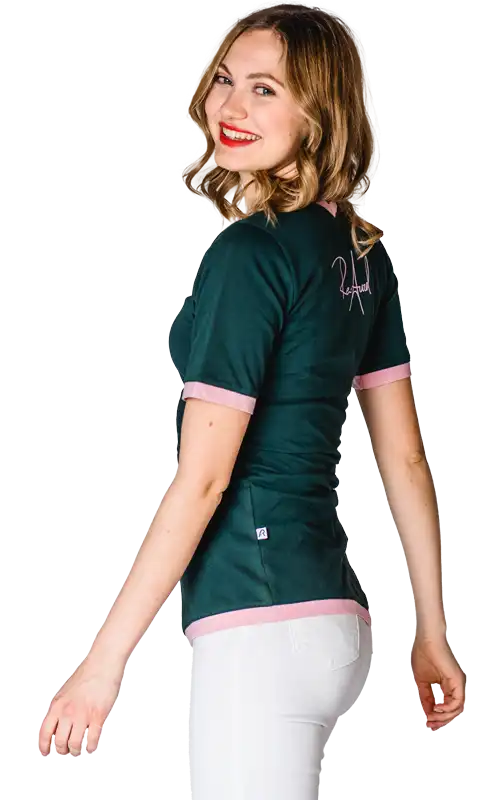
If your clothing feels interchangeable, the problem is usually not the textile alone. What is missing is a clear system of brand, cut, material, function and impact.
For companies that do not see clothing
as standard goods, but as part of their identity.